Flight From a Peace Officer in Calgary: Why No Pursuit Means No Conviction Under Section 320.17
TL;DR: Section 320.17 of the Criminal Code makes it an offence to fail to stop while being pursued by a peace officer. Pursuit is an essential element. If police do not follow your vehicle with the intent to stop it, there is no pursuit in law, and a flight from a peace officer charge cannot stand. Surveillance is not pursuit.
The Short Answer
Driving away from a traffic stop is not automatically criminal flight. The Crown must prove that a peace officer was actively pursuing your vehicle at the moment you failed to stop, and that you knew it. If officers turned off their lights, dropped back, switched to surveillance, or simply drove away, the pursuit element is missing. Prosecutors may still consider other charges, such as dangerous operation, but a charge under section 320.17 requires an actual pursuit.
Introduction: Flashing Lights, Silent Sirens, and Serious Charges
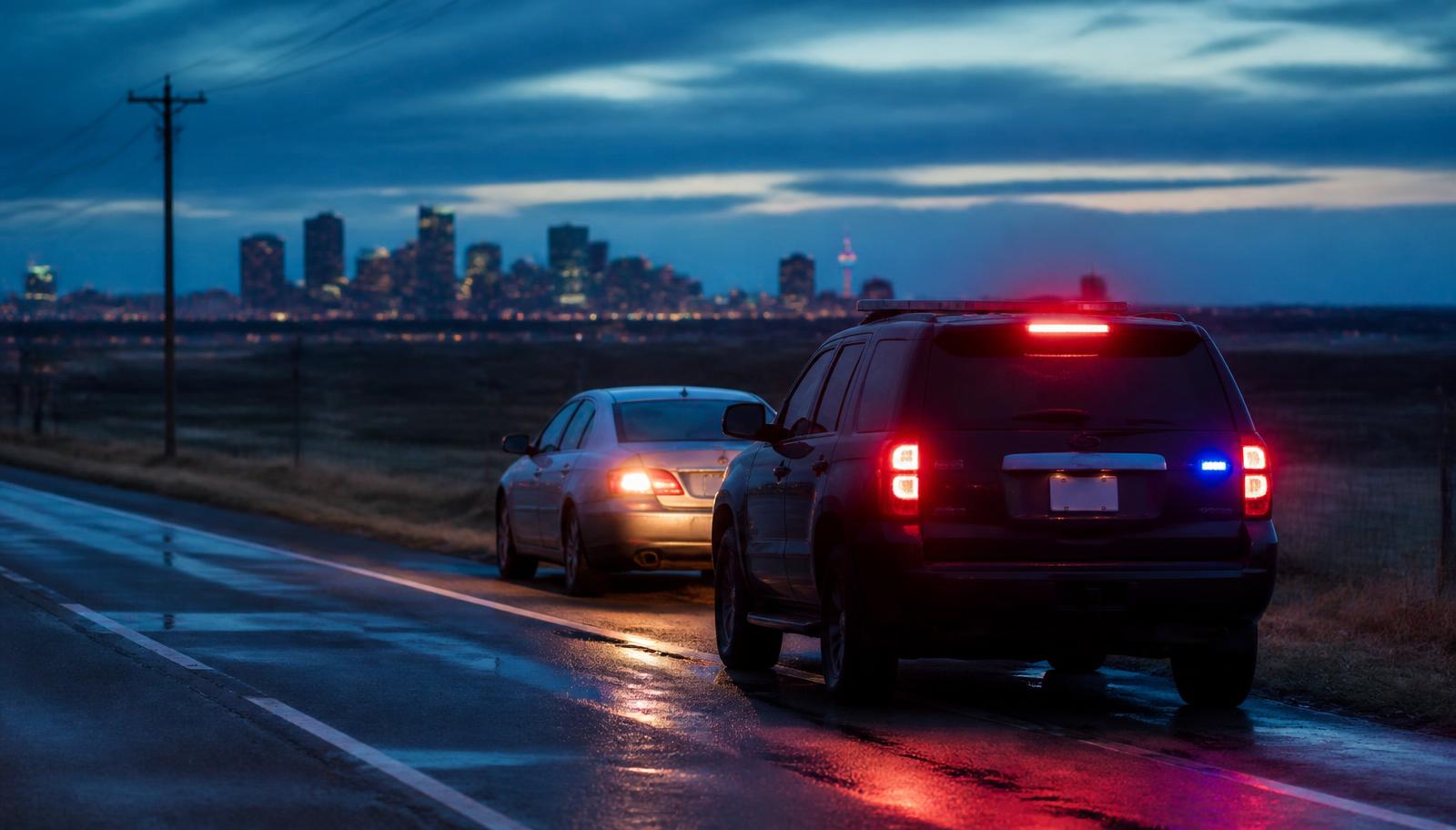
Imagine driving down a busy Calgary roadway when police officers initiate a traffic stop. You pull over, produce your documents, and wait while officers return to their cruiser. Minutes later, the interaction becomes tense or confusing. You decide to drive away. Officers do not turn on their sirens. They do not activate their overhead emergency lights. Instead, they turn off their lights and slowly drive in the opposite direction.
Hours or weeks later, police arrest you. Prosecutors charge you with flight from a peace officer under section 320.17 of the Criminal Code of Canada.
Many drivers assume that leaving a traffic stop automatically equals criminal flight. However, Canadian law requires prosecutors to prove every essential element of the offence. A critical element is that an active police pursuit must occur. If police officers choose to surveil your vehicle rather than chase it, there is no legal pursuit. Consequently, a charge under section 320.17 cannot stand in law.
This article examines the legal mechanics of section 320.17. We explore why courts reject expanded definitions of police pursuit. We also analyze how Charter rights protect drivers across Calgary, Alberta, the Prairies, Western Canada, and the Northwest Territories.
Understanding Section 320.17 of the Criminal Code
Section 320.17 of the Criminal Code addresses flight from peace officers. Parliament enacted this provision to punish drivers who provoke dangerous police chases on public roads. The statutory language states:
Everyone commits an offence who operates a motor vehicle or vessel while being pursued by a peace officer and who fails, without reasonable excuse, to stop the motor vehicle or vessel as soon as is reasonable in the circumstances.
To secure a conviction, the Crown prosecutor must prove three essential components beyond a reasonable doubt:
- Operation of a conveyance: You must operate a motor vehicle or vessel.
- Active police pursuit: A peace officer must actively pursue your vehicle at that exact time.
- Failure to stop: You must fail to stop as soon as reasonable without a lawful excuse.
This charge carries severe criminal penalties. Courts impose harsh sentences to denounce dangerous driving behaviour and deter police chases. However, the law distinguishes between dangerous driving and criminal flight. If your driving creates risk without an active police pursuit, prosecutors should charge dangerous operation under section 320.13(1), not flight under section 320.17. Anyone facing either allegation should speak with a lawyer who handles dangerous driving and other Criminal Code driving offences in Alberta.
The Essential Legal Element: What Constitutes a Pursuit?
The word pursuit is not a mere technical footnote. It represents the fundamental actus reus, or guilty act, of the offence. In recent years, some police officers and prosecutors attempted to stretch the definition of pursuit. They argued that any driver who pulls away from an investigative stop commits criminal flight.
Canadian courts firmly reject this overbroad interpretation. Trial judges emphasize that statutory interpretation must respect the ordinary, everyday meaning of words. In everyday language, pursuit means following someone with the specific intent to catch or stop them.
Leading Legal Authorities on Police Pursuits
Recent rulings clarify the strict boundaries of section 320.17. In R. v. Bell (2026 ONCJ 21), the court examined whether leaving a police stop constitutes flight when officers do not give chase. The judge held that pursuit requires police to follow a vehicle with the intent to stop it from driving away.
The court in Bell explained that Parliament designed section 320.17 to deter drivers from continuing to drive when police actively try to stop them. When police do not try to stop the vehicle, there is no pursuit in law. This legal reality remains true even when officers hold back for sensible public safety reasons.
The Nine Legal Principles of Police Pursuits
In R. v. Akuffo-Duncan (2026 ONCJ 144), the court synthesized Canadian case law into nine governing principles. These principles provide a clear roadmap for defending section 320.17 charges:
- Following with intent to stop: A pursuit requires police to follow a vehicle with the specific intent to stop it. Officers can catch up, overtake, or make tactical movements aimed at halting the vehicle.
- No following means no pursuit: If police officers do not follow the vehicle, no pursuit occurs. When officers take no active steps after a driver departs, the charge fails.
- A traffic stop is not an ongoing pursuit: A routine traffic stop does not constitute an active pursuit. Leaving a stopped position does not automatically transform into flight while pursued.
- Required mental element: The driver must possess subjective knowledge that police are actively pursuing them.
- Stopped versus pursued: Knowing that police stopped you earlier is not the same as knowing police are pursuing you now. Drivers cannot know they are pursued if officers do not follow them.
- Knowledge at the exact time: The driver must know of the pursuit at the exact moment they fail to stop. Subsequent police actions cannot retroactively create guilty knowledge.
- Imputing knowledge: Courts can impute knowledge from the surrounding context, but only if an actual pursuit takes place.
- Definition of pursued: To pursue means to follow with intent to stop or overtake. The movement may be slow or cautious, but it must aim to stop the vehicle.
- Respecting statutory text: Courts must preserve the ordinary meaning of pursuit. Judges cannot stretch the word to cover non-pursuit situations.
Active Pursuit Versus Covert Police Surveillance
Modern police tactics differ substantially from traditional highway chases. Police departments across Canada recognize the extreme safety hazards of high-speed pursuits. Consequently, many forces adopt restrictive pursuit policies.
For example, the Calgary Police Service enforces strict operational guidelines under its Code 600 Pursuits Policy. This policy instructs officers not to commence a pursuit, or to terminate an ongoing pursuit, when they already know the subject's identity. If an officer already inspected your driver's licence and registration, police policy often forbids a pursuit.
Surveillance Is Not Pursuit
When officers decide against a pursuit, they often switch to covert surveillance. Ground units turn off sirens and emergency lights. Officers deliberately drop back to remain hidden from the driver's view. In major cities like Calgary, police may call in aerial surveillance, such as the HAWC helicopter, to track vehicles from above.
Police surveillance serves investigative goals, but it lacks the statutory elements of section 320.17. You cannot flee from an officer who hides in a driveway or deactivates their lights. As courts confirm, calling an operation surveillance precludes prosecutors from claiming pursuit in court.
The Intersection of Pretextual Traffic Stops and Flight Charges
Flight charges frequently arise from questionable police traffic stops. Under provincial highway legislation, such as Alberta's Traffic Safety Act, police officers hold broad powers to stop vehicles. Officers can check driver sobriety, mechanical fitness, and valid licensing.
However, police officers cannot use traffic laws as an unlawful pretext or ruse. In R. v. Gallant (2024 ABKB 541) and R. v. Aujla (2021 ONSC 2417), courts examined stops conducted under the guise of minor traffic infractions. Judges ruled that officers must have a subjective, legitimate road safety purpose in mind.
Unlawful Drug Investigations and Ruse Stops
Sometimes, surveillance teams suspect a driver of drug trafficking but lack reasonable grounds to arrest or search. To bypass constitutional protections, drug units ask patrol officers to initiate a traffic stop for a minor issue like tinted windows.
If window tint is non-existent or legal, the traffic stop becomes an unlawful pretext. When police detain a driver without a genuine highway safety purpose, they commit an arbitrary detention under section 9 of the Charter. Any subsequent seizure of documents or vehicle searches violates section 8 of the Charter. These issues arise often in drug offence prosecutions in Calgary, where the lawfulness of the initial stop can decide the entire case.
Challenging Flight Charges: Key Charter Defences and Remedies
When facing a section 320.17 charge, a skilled defence lawyer scrutinizes the entire police interaction. Defence counsel will challenge both the statutory elements of the charge and any underlying Charter violations.
Lost or Deleted Evidence and Section 7 Rights
Police dashcam footage and body-worn camera recordings provide critical, unbiased evidence of driving patterns. Under the Supreme Court of Canada decision in R. v. Stinchcombe, the Crown has a strict constitutional duty to disclose all relevant evidence. This duty requires police to preserve investigative evidence.
When officers fail to preserve dashcam video or delete recordings, they infringe your right to make full answer and defence under section 7 of the Charter. In cases like R. v. Carosella and R. v. La, the Supreme Court held that unexplained destruction of relevant evidence violates fundamental justice. Missing video often prevents police from proving alleged driving erraticism or pursuit dynamics.
Charter Remedies: Stays of Proceedings and Evidence Exclusion
When police violate your constitutional rights, courts can grant powerful remedies under section 24 of the Charter:
- Stay of proceedings under section 24(1): A judicial stay permanently halts the prosecution. Courts grant stays in the clearest of cases where state misconduct irreparably prejudices trial fairness or undermines system integrity.
- Exclusion of evidence under section 24(2): Under the R. v. Grant framework, courts exclude unlawfully obtained evidence. Judges balance the seriousness of police misconduct, the impact on your rights, and society's interest in a trial on the merits.
Why Experienced Defence Representation Matters
Defending against driving and flight charges requires deep technical knowledge of criminal law and police procedures. Police reports often label covert surveillance as a pursuit to justify serious criminal charges. An experienced Calgary criminal lawyer will cross-examine police officers, analyze radio transcripts, and demand all aerial or body-worn camera evidence.
While our legal team is based in Calgary, Alberta, we regularly defend clients across Alberta courts. Whether your charge arises on a Calgary street or along the Trans-Canada Highway, robust constitutional defence is essential.
Conclusion and Key Takeaways
Understanding your legal rights during traffic stops and surveillance operations can protect you from unlawful convictions. Keep these key principles in mind:
- Pursuit is mandatory: Section 320.17 requires an active police pursuit. Surveillance is not pursuit.
- Intent to stop: Police must actively follow your vehicle with the intent to stop it.
- Pretext stops are unlawful: Police cannot use minor traffic rules as a ruse for warrantless criminal investigations.
- Missing evidence matters: The deletion or loss of police video footage can trigger a Charter stay of proceedings.
- Constitutional protections apply: Sections 7, 8, 9, and 10 of the Charter protect against arbitrary detention, unlawful search, and unfair trials.
If you are facing flight from a peace officer, dangerous driving, or related charges in Calgary, contact Hoare Claxton for a free consultation at (587) 355-8889 or through our contact form.
This post is for informational purposes only and does not constitute legal advice. Consult a qualified lawyer for your specific situation.