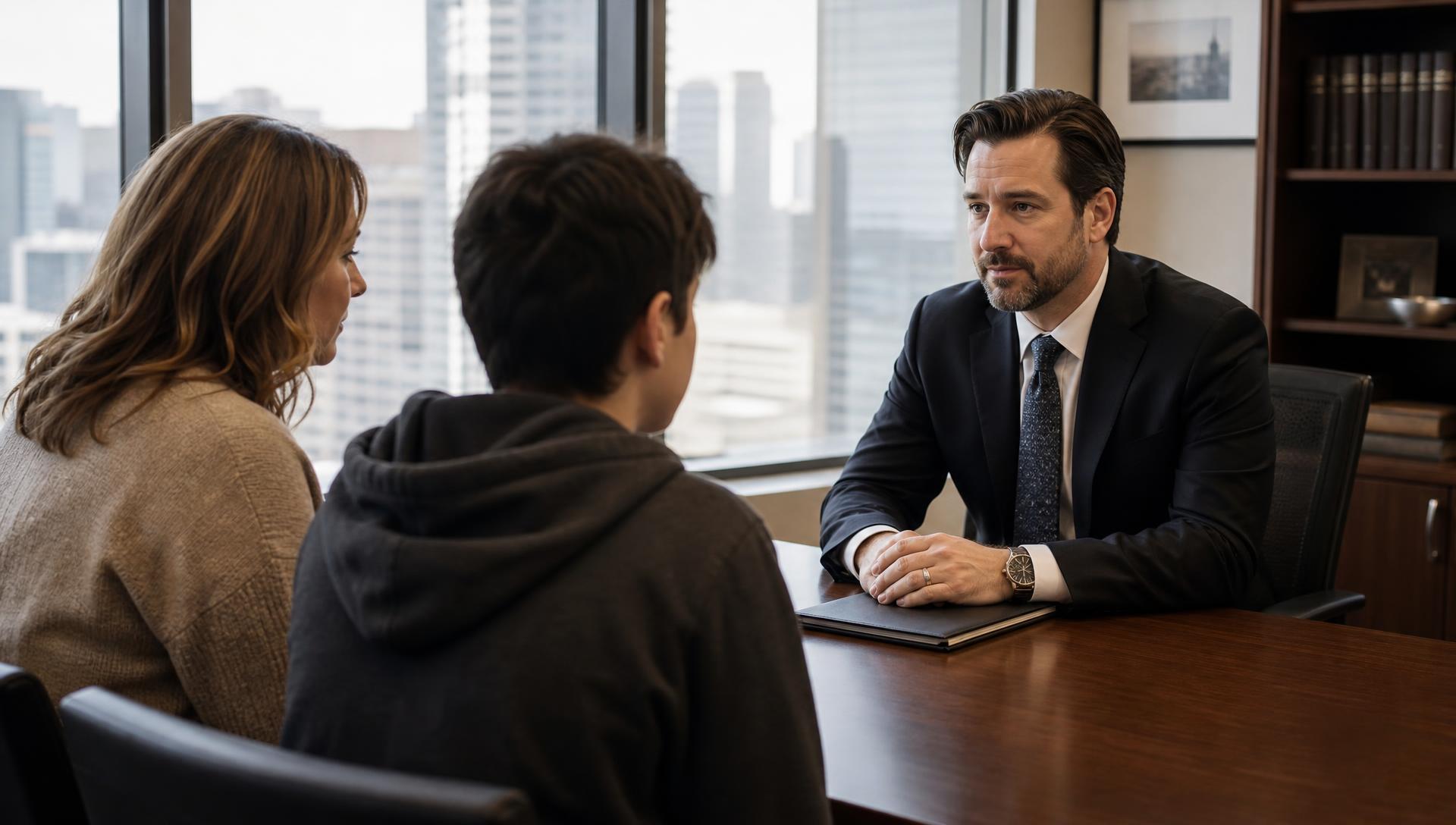

Calgary Youth Criminal Lawyer (YCJA Defence)
We defend young persons aged 12 to 17 prosecuted under the Youth Criminal Justice Act in Calgary, from the police station through to trial.
This page was written by the criminal defence lawyers at Hoare Claxton based on their experience appearing in Calgary courts. It is reviewed periodically for accuracy.
Our office is steps from the Calgary Courts Centre, where the majority of our criminal cases are heard.
Receiving a phone call that your child has been arrested is one of the most frightening moments a parent can experience. The panic arrives fast, and it usually arrives in the same order: Will they be kept in a cell tonight? Will a mistake made at fifteen follow them into university, into work, across a border?
We want to begin with the most important thing we can tell you. A youth charge does not automatically mean a ruined future. The entire statute is built on that premise.
In Canada, young people who were between 12 and 17 years old at the time of the alleged offence are prosecuted under the Youth Criminal Justice Act (YCJA), not the adult system. What matters is their age when the offence is said to have occurred, not their age today: a nineteen-year-old charged with something alleged to have happened when they were sixteen is still dealt with as a young person. A child under twelve cannot be charged with a criminal offence at all, and those situations are addressed through Alberta's child intervention system instead.
In Calgary, these matters are heard in the Family and Youth Division of the Alberta Court of Justice at the Calgary Courts Centre. The same division also handles provincial and municipal charges laid against young persons under Alberta's Youth Justice Act, which is why a sixteen-year-old's driving matter can end up in the same courtroom as a theft allegation.
The youth system is organised around rehabilitation, accountability and reintegration rather than deterrence and punishment. But it is still a criminal prosecution. Police and Crown prosecutors take these files seriously, and without experienced counsel a young person can face real consequences, including time in a youth facility and a record that stays open well into their early adult years.
Protecting your child's rights, their privacy and their future begins the moment they are detained.
Speak to a Youth Defence Lawyer
Is your child with police right now? Call our Calgary office at (587) 355-8889. We answer after hours. If you need one of our lawyers to attend at the police station, please call rather than using the intake form.
Will My Child Be Released? (Youth Bail)
For most parents this is the first question, and the answer is more often reassuring than not.
The YCJA makes detention harder to justify for a young person than for an adult. A youth justice court cannot order a young person detained unless, among other requirements, the young person could actually be committed to custody if they were found guilty. The Act also expressly prohibits using detention as a substitute for child protection, mental health or other social measures. A young person should not be held in a cell because there is nowhere else for them to go.
The Act also creates a route with no adult equivalent: release to a responsible person. A parent, relative or other suitable adult can sign an undertaking to take responsibility for the young person, supervise them, and ensure they attend court. Where a young person would otherwise be detained, that undertaking is frequently what gets them home.
Signing carries real obligations, and we will explain precisely what you are agreeing to before you do. In many of our files, a parent's willingness to act as a responsible person is the most useful thing available to us at the bail stage. Our Calgary bail hearing lawyers can attend on short notice.
Can My Child's Charges Be Dropped? (Extrajudicial Measures and Sanctions)
The most common question we hear is whether the whole thing can simply go away. Frequently, it can.
Parliament wrote a presumption into the YCJA: where a young person has no prior findings of guilt and the alleged offence is non-violent, measures taken outside the court process are presumed to be adequate to hold them accountable. That presumption is the foundation of every diversion argument we make.
The least intrusive options
Before anyone reaches court, police have the power to take no further action, issue a warning, administer a formal caution, or, with the young person's consent, refer them to a community program. A Crown prosecutor has similar options, including a Crown caution. In Calgary, first-time minor offences are often handled through the Community Program Referral stream, administered by the Calgary Police Service youth diversion team in partnership with the Calgary Youth Justice Society. A great many youth files end here, and they end quickly.
Extrajudicial Sanctions (EJS)
Where a warning or caution is not enough but full prosecution would be excessive, the matter can go to the Extrajudicial Sanctions program, known in Alberta for many years as Alternative Measures. A referral can be made before a charge is laid, in which case no charge is ever filed, or after, by the Crown or by the court. EJS requires Crown approval, and it requires your child to accept responsibility for what happened and agree to take part.
Eligibility in Alberta generally turns on an eligible offence, a first or second involvement with the justice system (there are limits on how often a young person can be referred within a two-year window), acceptance of responsibility, and agreement to participate. Minor theft, mischief, simple possession and less serious assaults are common examples.
Your child then appears before a community Youth Justice Committee, which assigns the sanctions. These commonly include:
- a set number of community service hours
- a letter of apology to the person harmed
- restitution for property damaged or taken
- an educational or counselling program
Programs typically run about three months. On successful completion of a post-charge referral, the charges are withdrawn. There is no plea, no trial, and no conviction. On a pre-charge referral, no charge is ever laid in the first place.
One point we want to be clear about, because it is frequently misstated: completing EJS does not mean nothing is written down. A record of the sanction itself is kept, and it stays accessible for two years from the day your child agreed to it. It is not a criminal conviction, it will not appear on a standard criminal record check once those two years close, and it will not follow your child into adult life. But if your child is charged again inside that window, it can be raised. We tell every family this at the outset so that nobody is surprised later.
Mental health diversion
Where charges appear connected to a mental health or addiction concern, the Provincial Mental Health Diversion Program is a separate route. It is run by Recovery Alberta together with the Alberta Crown Prosecution Service, and delivered in Calgary through Calgary Diversion Services. Referral must come from the Crown prosecutor, and it must be approved before a plea is entered or a sentence imposed, which is why timing matters so much. Clinicians assess suitability and set goals with the young person; the adjournment period for young persons averages about four months. On successful completion, the charges are withdrawn at the final court date. The program excludes high-risk and violent offences, and it is aimed at genuine mental health and addiction concerns rather than general difficulty at home or school.
None of this happens automatically
Police and the Crown must agree that your child is a suitable candidate, and the window for some of these options closes early. Our role at this stage is to put your child's background, family support, school situation and circumstances in front of the right prosecutor at the right moment, before positions harden and before a plea forecloses options.
Youth Rights During Police Questioning
Some of the most consequential events in a youth file happen before a parent even knows there is a file.
Recognising the pressure a teenager is under in an interview room, section 146 of the YCJA gives young people protections well beyond the adult Charter rules. Before a young person's statement to a person in authority (usually a police officer, though the category is broader) can be used against them, the young person must have been told clearly, in language suited to their age and understanding:
- The right to silence. They do not have to say anything, and anything they do say can be used as evidence against them.
- The right to counsel. They may speak privately with a lawyer before answering any questions.
- The right to adult support. They may consult a parent, guardian or other appropriate adult, and they are entitled to have both that adult and their lawyer present in the room while they are questioned.
What if the police did not follow the rules?
A young person can waive the right to have a lawyer and an adult present, but the waiver has to be recorded on video or audio, or set out in writing and signed. The Supreme Court of Canada has held that the Crown must prove beyond a reasonable doubt that the rights were properly explained and that any waiver was genuinely informed. That is a demanding standard, and it is one of the strongest tools available in youth defence.
We review the complete video and audio of every police interview in a youth file. Where section 146 was not complied with, we bring an application to have the statement excluded, including a full confession.
Excluding a statement does not by itself end a prosecution. But where the statement was the Crown's principal evidence, its exclusion often does.
Advice for parents. Tell your child that if they are stopped, detained or arrested, they should be polite, identify themselves, and then say clearly that they want to speak to a parent and a lawyer and do not wish to give a statement. Then call us. Staying silent is not an admission of anything, and a young person in an interview room is in no position to judge which answers help and which ones hurt. The right to have you and a lawyer present is your child's to insist on.
Will My Child Have a Permanent Criminal Record?
Most likely not. But the accurate answer is more specific than the common myths, and the specifics are worth understanding, because they are what we are negotiating over.
Privacy and publication bans
The YCJA protects a young person's identity. It is an offence to publish the name or identifying information of a young person dealt with under the Act, and that applies to the media and to the general public, social media included. The ban is strong but not absolute. It does not apply where an adult sentence is imposed. A court can lift it in narrow circumstances, including where a young person is at large and poses a danger. The Crown can apply to lift it where a youth sentence is imposed for a serious violent offence. And a young person may choose to publish information about themselves once they turn 18, provided they are not in custody.
Who can see the record
The general public and prospective employers cannot look up a youth record. The Act does permit disclosure to a school representative in defined circumstances: to ensure compliance with a court order, to protect the safety of staff or students, or to support the young person's rehabilitation. That disclosure carries its own confidentiality obligations, and it is one of the things we watch closely where a school matter is running in parallel.
How long the record stays open
There is a persistent myth that youth records vanish on a person's eighteenth birthday. They do not. Each outcome carries its own statutory "access period":
- How the matter was resolved
- Extrajudicial sanction
- Access period
- 2 years from the date your child consented to the sanction
- How the matter was resolved
- Charge withdrawn or dismissed; finding of guilt with a reprimand
- Access period
- 2 months
- How the matter was resolved
- Acquittal
- Access period
- 2 months after the appeal period expires (3 months if appealed)
- How the matter was resolved
- Charge stayed, with no further proceedings for a year
- Access period
- The end of that year
- How the matter was resolved
- Absolute discharge
- Access period
- 1 year from the finding of guilt
- How the matter was resolved
- Conditional discharge
- Access period
- 3 years from the finding of guilt
- How the matter was resolved
- Summary conviction offence
- Access period
- 3 years from completion of the sentence
- How the matter was resolved
- Indictable offence
- Access period
- 5 years from completion of the sentence
Where a sentence includes probation, the three- or five-year clock does not begin to run until the probation period ends. Once the access period expires, the record is closed: it cannot lawfully be disclosed without a court order, and it will not appear on a standard criminal record check.
This table is also why the particular outcome matters so much. On the same facts, the difference between a conditional discharge and a summary conviction can be the difference between a record that closes three years after the finding of guilt and one that stays open for years after the sentence has been served.
The exception every parent should understand
If your child is found guilty of a youth offence and then commits another offence after turning 18, while the youth access period is still running, the youth record can be treated as part of their adult criminal record. Staying out of trouble through that period is not a formality. It is the thing that makes the record disappear.
A caution about travel
The YCJA binds Canadian courts, police and agencies. It does not bind foreign governments. United States border officers are not governed by the Act, and admissions made to a border officer can create immigration problems independent of how a Canadian charge was resolved. Tell your child never to discuss a past charge at the border without speaking to us first.
Sentencing Under the Youth Criminal Justice Act
If a matter cannot be diverted and results in a guilty plea or a finding of guilt at trial, the court must decide on a sentence. For most parents this is the most difficult stage to sit through.
Youth sentencing runs on its own principles. The law recognises that young people have diminished moral blameworthiness compared with adults. A youth sentence must be proportionate to the offence and to the young person's degree of responsibility, must account for their level of maturity, and must promote rehabilitation and reintegration rather than simply punish or deter.
Community-based sentences
The Act places heavy emphasis on keeping young people in their communities. The available options include:
- Reprimand. A formal warning from the judge and nothing further. The record closes two months later.
- Absolute or conditional discharge. A finding of guilt with no further penalty (absolute), or subject to conditions for a set period before the discharge takes effect (conditional).
- Community service or restitution. Unpaid work in the community, or compensation to the person harmed.
- Probation. Up to two years, on conditions such as a curfew, school attendance, or counselling.
- Deferred custody and supervision order. A custodial sentence served in the community on strict conditions, available where the offence is not a serious violent offence. A breach can mean serving the balance in custody.
Custody as a last resort
Many parents assume custody is the default. It is not. A youth justice court cannot impose a custodial sentence unless one of four conditions is met: the young person committed a violent offence; they have failed to comply with previous non-custodial sentences; they committed an indictable offence for which an adult would face more than two years and they have a history of findings of guilt; or the case is an exceptional one in which the aggravating circumstances make a non-custodial sentence inconsistent with the Act's sentencing principles. Even where one of those gateways is open, the court must first consider all reasonable alternatives.
Where custody is imposed, the standard order divides the sentence: a period in a youth facility, followed by a period of supervision in the community on conditions. Youth sentences are also capped. The general maximum is two years, rising to three years where an adult could receive life, and for murder, ten years for first degree and seven years for second degree.
Can my child be sentenced as an adult?
In law, the Crown may apply for an adult sentence whenever the young person was 14 or older at the time of the offence and the offence is one that carries more than two years' imprisonment for an adult. That is a wide category on paper. In practice these applications are uncommon and are reserved for the most serious files.
Several protections apply. The Crown must give notice of its intention before the young person enters a plea. Where an adult sentence is sought, the young person gains the right to elect trial by judge and jury.
And the Crown carries the burden of satisfying the court that a youth sentence would not be long enough to hold the young person accountable, a burden shaped by the Supreme Court's recognition in R v D.B. that young people are less morally blameworthy than adults. If an adult sentence is imposed, adult penalties and parole rules apply and the publication ban no longer protects the young person's identity, although a young person under 18 is ordinarily placed in a youth facility.
Contesting an adult sentence application is among the most serious work we do. We use psychological and psychiatric assessments, pre-sentence reports, school and treatment records and character evidence to demonstrate that a youth sentence is sufficient to hold the young person accountable while preserving their prospects.
What Parents Should Do Right Now
- Call a lawyer before your child speaks to police. The interview is usually the point at which a file becomes much harder or much easier to defend.
- Expect to be notified, and expect to attend. The YCJA requires that a parent be notified when a young person is arrested and detained or charged, and the court can order a parent to attend. Judges notice which parents are in the room.
- Be ready to act as a responsible person. It is often the difference between your child coming home and your child being held.
- Start supports now, not later. Counselling, tutoring, employment, volunteer work, treatment. Steps taken before sentencing carry far more weight than steps promised at sentencing.
- Say nothing publicly. The publication ban protects your child. It also binds you, and it binds their friends and their friends' parents.
- Know that cost need not be a barrier. Every young person has the right to counsel at every stage, and where a young person cannot obtain a lawyer, the court must direct that one be provided. Legal Aid Alberta assesses the young person's own means rather than their parents', so most young people qualify. What retained counsel adds is availability in the hours and days before charges are laid: at the police station, and during the window in which diversion decisions are actually made.
How We Defend Youth Files
Hoare Claxton is a criminal defence firm in downtown Calgary. Our lawyers appear in the Alberta Court of Justice regularly, and we work youth files collaboratively. You are not retaining a single lawyer in isolation; five criminal defence lawyers review strategy on the files that need it.
Our approach to youth matters is front-loaded, because that is where the leverage is. We engage with the Crown early, before positions harden, to put your child's background, family support and circumstances on the table while diversion is still available. We scrutinise the police interview for compliance with section 146.
Where the matter has to be litigated, we litigate it. Where it has to be resolved, we work toward the resolution that closes the record soonest.
We cannot promise you an outcome, and you should be cautious of anyone who does. What we can tell you is that in this system the decisions made in the first days often matter more than anything that happens later, and that is where we concentrate.
A mistake made today should not define who your child becomes.
Contact Us
Call our Calgary office at (587) 355-8889 or complete our confidential intake form. We answer after hours.
Contact Hoare Claxton
If your child is with police right now, please call rather than using this form so a lawyer can attend.
You can also read about bail hearings in Alberta or meet our Calgary defence team.
This page provides general information about the law in Alberta. It is not legal advice, and reading it or contacting us does not create a solicitor-client relationship. Every case turns on its own facts. If your child has been charged or is under investigation, please speak with a lawyer about your specific circumstances.